
For people who run a business, not a marketing team
Type in your website.
Get three things to do this week.
We check the map around your door, your Google results, what ChatGPT says when someone asks for your trade, and what is broken on your own site. Then we tell you the three things worth doing this week, in the order that matters. One login, nothing to install.
Every tool is live. Sign up with Google in under a minute, type your website and get your first three things to do today. Business is $49/month with credits included. No second bill.
What gets checked

An example scan. Yours runs on your address and the words your own customers type.
points checked around your door, instead of one average for the whole town
checks that run on their own, from the one thing you type
things to do each week, in order — never a list of forty
percentages, acronyms or charts you have to learn to read
The difference
Same Monday. Same business.
Nothing about your work changes. What changes is that you stop guessing which part of it needs you today.
Monday, without it
You open the laptop and guess.
- ×You search your own trade on your phone and hope you show up. You do, from your desk. What happens four streets away, you do not know.
- ×Someone said ChatGPT recommends businesses now. You typed a question once, did not see yourself, and closed it.
- ×Two pages on your site have been broken since the redesign. Nobody told you.
- ×A competitor is getting the calls. You do not know which one, or why.
- ×You paid for a report last month that you did not read.
A whole morning. No decisions made.
Monday, with it
You open one screen and read three lines.
- ✓You lost the map in two neighbourhoods this week. Here they are, and here is the one change that moves them.
- ✓ChatGPT names you in 4 answers out of 10. These six questions leave you out — someone else is named instead.
- ✓Two pages return an error. Here are the addresses.
- ✓Your Google listing has no Saturday hours. People searching on a Saturday do not see you.
- ✓Everything else is fine. Nothing else needs you today.
Four minutes. Three things to do.
One platform
Everything about how customers find you, in one place.
Where you come up on Google. Where you show on the map around your address. What ChatGPT says when someone asks for your trade. What is broken on your own website. Which businesses are getting the calls you are not. All of it checked for you, on a schedule, without you opening anything.
And then the part that matters: the reading is already done. Not a summary of numbers — the actual decision. Do this, then this, then this, and here is why each one is worth your afternoon.
You sign up, you type your website, and it starts. Nothing to install, nothing to connect, nobody to hire to run it for you.
Eight things, one login. Which limits apply to which plan is on the pricing page.
And then it hands you the work
Links, words and watching. From the same screen.
Measuring is the easy half. The half nobody sells you is what to do on Monday morning: which site to email, which page to write, and what to stop worrying about.
Backlink ideas, before you ask
The sites that link to the businesses winning the calls you are not and not to you, ordered by how reachable each one is, with the reason to get in touch and which page of yours is worth pointing at.
What to write next
The topics your competitors have a page for and you do not, plus every service on your own site with nothing behind it. Each one arrives with what the page has to cover and why it is worth the hour.
All of it watched, in one history
Map, Google, AI answers, your site’s health, your rivals and your links, checked on a schedule and kept in one place — so you can see what your last change actually did.
Rankfinity finds the opportunities and writes the brief. It does not buy links and it does not publish for you: the two things that get sites penalised are the two things you keep in your own hands.
One box in
Six checks, and you run none of them.
You give one thing — your website address. Everything below happens on its own, the first time and every week after.
Your website
Every page we can reach: what each one is about, what is missing, what is broken, and which of your services have no page at all.
Your Google listing
If you have one, we find it from your website: categories, hours, photos, reviews, and the fields you left empty years ago.
The map around you
Not your position in the city. Your position street by street, at 49 points around your address, because that is how people actually search.
Google results
Where you land for the words your customers type, tracked over time, so you can see whether the change you made did anything.
AI answers
What ChatGPT, Gemini, Perplexity, Claude, DeepSeek, Grok, Mistral and Google’s AI Overviews and AI Mode say when someone asks to recommend a business like yours — whether you get named, and who gets named instead.
Whoever is ahead
The businesses beating you, what they have that you do not, and the exact pages of theirs doing the work.
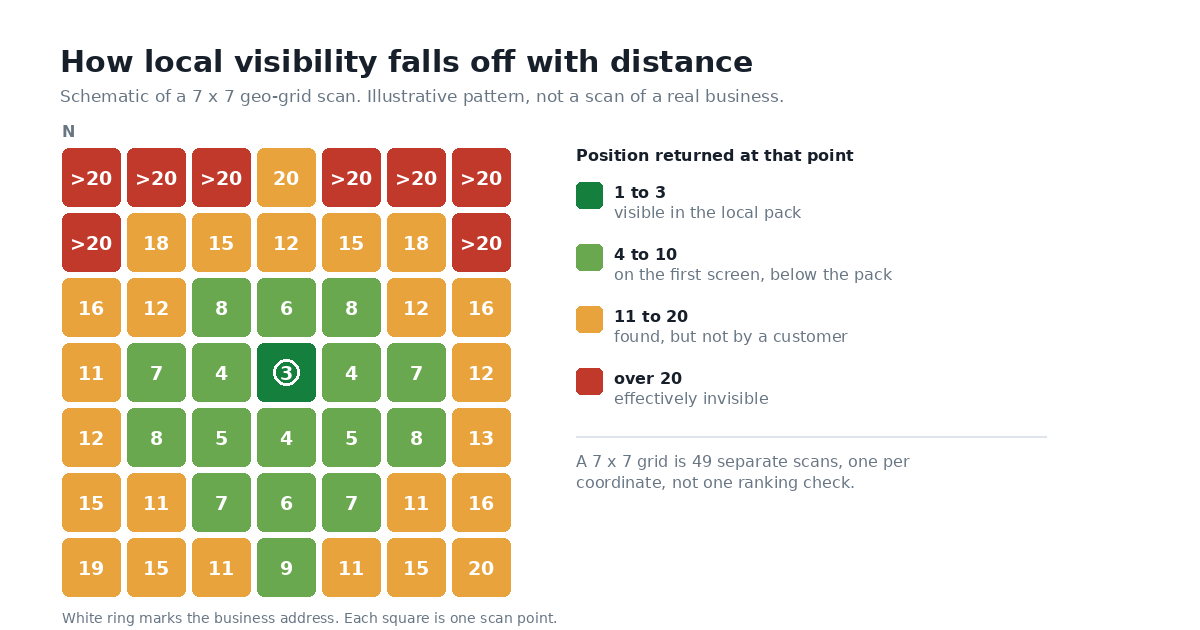
Why one number lies
Where you show up depends on where the customer is standing.
You can be third in your own doorway and nowhere four streets away. We check forty-nine points around your address, so you see the streets where people find you and the streets where they find somebody else.
Green is where you get the call. Red is where someone else does. Everything Rankfinity tells you to do comes out of moving red towards green, in the order that moves the most of it.
Plain English
Written the way you would say it.
No percentages to decode, no acronyms to look up. Every number arrives as a sentence you can act on. That is a rule in the code, not a style preference.
The assistant
Eight questions, already written.
An empty chat box is a wall. So the first screen is the set of questions you were going to ask anyway. Press one and the answer is built from your own numbers.
Three things, and the first one is worth more than the other two together.
Why
- You are invisible on the whole eastern side of your grid — 17 of 49 points show no listing at all.
- Two of the five services on your homepage have no page of their own, and both come up in AI answers for your trade.
- 340 people a month land on a page of yours that has no phone number on it.
What to do
- Write the two missing service pages. One page each, your own words, the town name in the title.
- Put the phone number on that page. Top and bottom.
- Add three photos to your Google listing. The most recent one is from 2023.
An illustration of the format and the language. Your answer is built only from your own data, and every number in it links back to the screen it came from.
The part that matters
It says “I don’t know” instead of guessing.
It only speaks from your data
The assistant cannot answer from general knowledge. If we have not measured something for your business, it says so and offers to go and measure it. A confident wrong answer costs you a weekend and a bill, which is worse than no answer.
Every number carries its source
Each figure links back to the screen it came from, so you can look at the thing itself. An answer that cannot cite its own numbers never reaches you.
No promises about rankings
Nobody can promise you first place, and anyone who does is selling. You get what is measurably true today and the actions most likely to move it.
You never have to work out what to do
All of the deciding is done for you: which page, what it has to cover, which site to email, in what order. The typing stays yours, because that is the part your customers can tell was outsourced, and the part Google keeps getting better at spotting.
The whole app
Four screens. That is all of it.
There is a version of this with twelve tabs, saved reports and export settings. It is for people who do this for a living. This is not that version.
Assistant
Where you land. Eight questions ready to press, and a box for anything else about your business.
How I am doing
One screen. Where you show up, where you do not, and whether this month is better than last.
Who is ahead
Up to five businesses beating you, and one sentence each on why they are.
What to do
A short list with tick boxes. Each item says why it matters and what it should change.
Doing this for other people?
Then you want the full version: many projects, white-label reports and share links. You can also hand any client this simple view of their own account, without teaching them a single acronym.
Before you ask
The questions everyone sends first.
Do I need to know anything about SEO?
No. That is the entire point of this version. If a screen shows you a percentage or an acronym, it is a bug and we want to hear about it.
What do you need from me?
Your website address. Your services, your location, your Google listing and your competitors are worked out from it and shown back to you, so you can correct anything we got wrong.
What if I do not have a Google Business Profile?
The map checks switch off and everything else still runs. If you sell online rather than from an address, that is the normal setup.
Will it do the work for me?
It does all of the deciding and none of the typing. You get the order, the reason and the brief for every item; adding the photo or publishing the page stays with you, which is what keeps the site yours and out of trouble.
Do I still need an agency?
Most of what an agency charges for is somebody reading the numbers and deciding what comes next, and that is the part this does. A report tells you what happened last month; this tells you what to do on Monday. Some owners keep an agency for the doing. Plenty find they have stopped needing one.
Do I have to connect anything else?
No. There is no second tool to buy, no plugin to install and nothing to import. If you want to plug in Search Console or Analytics you can, and the answers get sharper, but the whole thing works from your website address alone.
When can I start?
Early access opens in stages, smallest group first. Leave your website below and you go into that queue in order.
One box. Then you can stop guessing.
Plans start at $29 a month. Nothing to install, nothing to connect, no call to book.
Every tool is live. Sign up with Google in under a minute, type your website and get your first three things to do today. Business is $49/month with credits included. No second bill.